How Do I Know If My Mutual Funds Are Actually Performing Well?
The Challenge Facing the DIY Investor
 # How Do I Know If My Mutual Funds Are Actually Performing Well?
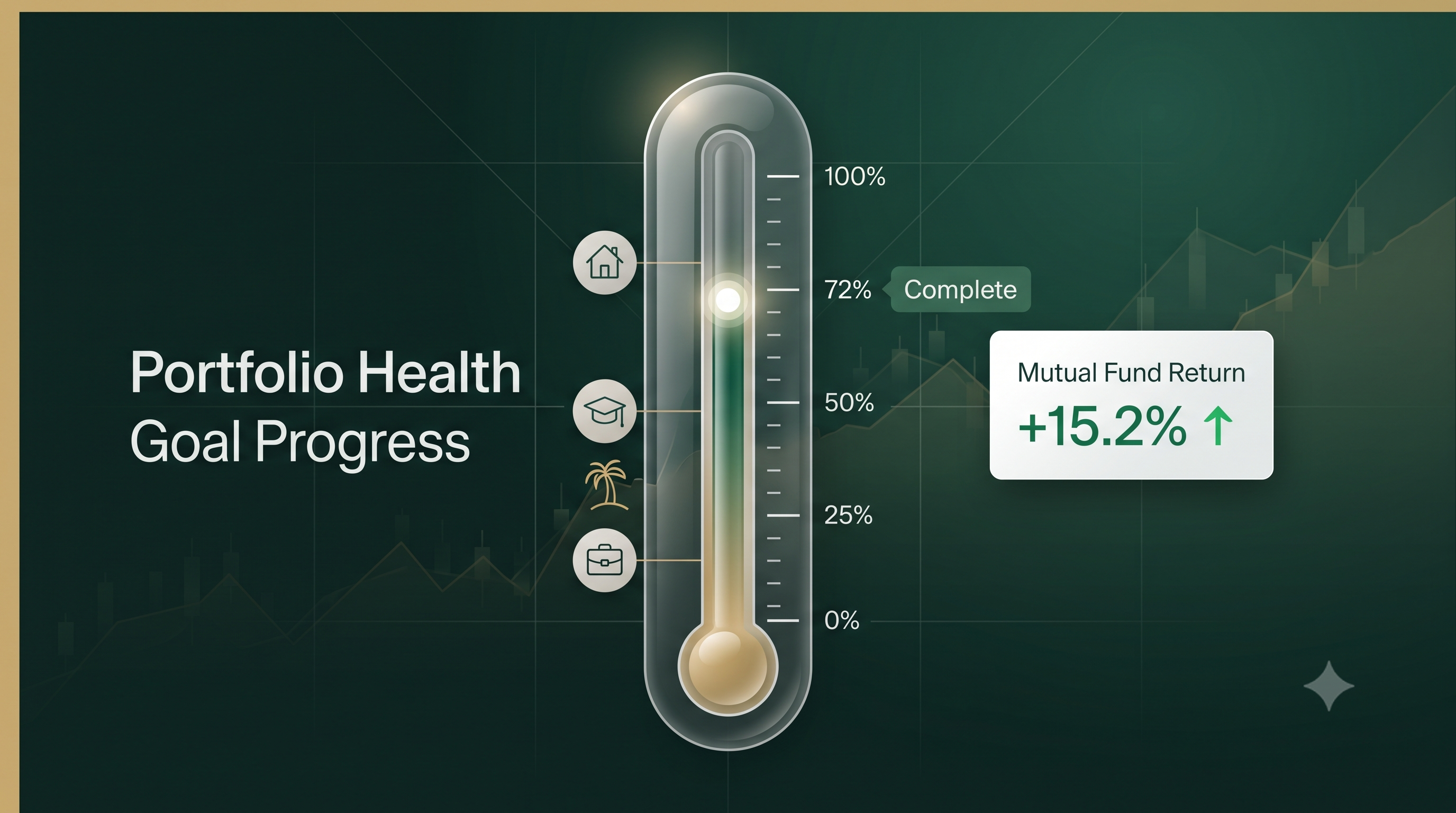
Most investors evaluate their mutual fund performance through a single metric: the return figure displayed on their investment app. A positive number is often interpreted as confirmation that the investment is performing well. This assumption, however, is frequently incorrect.
A fund delivering a 15% return may still be underperforming relative to its objective. Conversely, a fund returning 9% may be performing exactly as intended. The return figure in isolation offers limited insight. What matters is the context against which that figure is measured.
This article outlines the correct framework for evaluating mutual fund performance.
## Understanding the Risk-Return Relationship
The market comprises a wide spectrum of funds and ETFs, with annual returns ranging from approximately 3-4% to 30-50%. This variance is not arbitrary; it is a direct function of risk. A debt fund returning 4% per annum is fulfilling its intended role: capital preservation with modest, stable growth. A small-cap or sector-specific fund targeting 30-50% returns is assuming considerably higher volatility to pursue that outcome, and is equally capable of significant decline in an adverse market cycle.
Higher risk correlates with higher potential return; lower risk correlates with lower potential return. This is a structural principle of markets, not an anomaly. Consequently, the appropriate first question is not whether a return figure appears favourable, but whether it is appropriate given the level of risk undertaken. A 12% return from a balanced fund may represent strong performance. The same return from a fund positioned for aggressive growth may represent underperformance.
## Measuring Performance Against Financial Goals
This is the area where even experienced investors frequently err.
Consider an investor whose objective is retirement planning, requiring a portfolio growth rate of approximately 12% per annum to meet the target corpus within the intended timeline. If the fund consistently delivers returns close to that 12% benchmark, it is fulfilling its purpose, irrespective of how other funds in the market are performing. A fund reporting a 22% return elsewhere in the market is not a relevant comparison, as it is not calibrated to this investor's specific objective.
If, however, the fund consistently falls short of the return required to meet the stated goal, this constitutes a clear signal for portfolio review. This may involve rebalancing, switching schemes, or revising contribution amounts. The governing principle is straightforward: the investor's financial goal should serve as the primary benchmark, not general market sentiment.
In addition to goal-based evaluation, investors should assess how a fund is performing relative to its own category. A large-cap fund should be benchmarked against other large-cap funds, not against a small-cap fund pursuing a fundamentally different risk-return profile. Outperforming the category average over a 3-5 year horizon is a favourable indicator. Consistent underperformance relative to category peers over multiple years warrants attention.
## The Challenge Facing the DIY Investor
Investors who manage their portfolios independently through platforms such as Groww or Zerodha are, in effect, functioning as their own fund managers. There is no automatic mechanism tracking category benchmarks, recalculating the return required to meet personal goals, or flagging deviation from a fund's stated mandate. This responsibility rests entirely with the investor.
For a trained professional, such as a CFA or CA, this is a manageable undertaking. For the majority of investors, it represents an accumulating risk that often goes unnoticed until a financial goal falls short, by which point corrective action becomes considerably more difficult.
This does not necessitate abandoning a self-directed investment approach. It requires a structured system to make that approach more reliable.
## VPW Labs: A Goal-Tracking Resource for the Self-Directed Investor
This is the objective behind **VPW Labs** (labs.onlyvpw.com), a complimentary tool developed by VPW Wealth and powered by our proprietary Victoria Intelligence engine. It is designed to provide underprevileged investors — individuals who may not have access to a personal wealth manager but require a disciplined, structured approach to financial planning — with a reliable method of assessing whether their investments are genuinely on track.
The platform enables investors to:
- **Define a financial goal** — retirement, home purchase, education planning, or any comparable objective — and calculate the exact rate of return required to achieve it.
- **Establish yearly targets**, converting a long-term objective into a concrete, measurable figure for each financial year.
- **Record actual figures** at the close of each financial year and immediately view the variance between target and outcome.
- **Access AI-driven analysis** to understand the underlying reasons for underperformance or goal shortfall, with practical guidance on next steps.
This transforms portfolio monitoring from an assumption into a verified, data-backed process, at no cost to the investor.
## When Independent Management Is No Longer Sufficient
In certain circumstances, the gap between current portfolio performance and stated financial goals exceeds what a self-monitoring tool alone can resolve. Portfolios accumulated across multiple platforms, holdings with no coherent strategic alignment, and the cost or inconvenience associated with engaging a traditional financial advisor are common obstacles.
For these circumstances, **VPW** (www.onlyvpw.com) offers an AI-powered wealth management solution built specifically for India's mass affluent investor segment. VPW provides comprehensive, end-to-end planning, investment, and portfolio management services, removing the operational burden of continuous tracking, rebalancing, and goal-based evaluation from the investor. VPW operates on a transparent, plan-based fee model, with the entry-level **FIRST** plan available at **₹599 per annum** — a fraction of conventional advisory costs, delivered with institutional-grade rigour.
## A Practical Evaluation Checklist
Investors are encouraged to consider the following questions:
1. Is the required rate of return for each financial goal clearly defined, or is performance being assessed against a general expectation of "high returns"?
2. Is fund performance being benchmarked against comparable funds within the same category, rather than the highest-performing funds in the broader market?
3. Has portfolio performance been formally reviewed within the last twelve months, using actual figures rather than general impression?
4. If performance is lagging, is there a defined plan to address the shortfall?
An unfavourable response to any of the above warrants further review.
## Conclusion
An increase in a fund's value does not, by itself, confirm sound performance. Genuine performance evaluation requires assessment against risk, category benchmarks, and — most critically — the investor's defined financial goals. Investors seeking a structured, cost-free approach to this evaluation can begin at **labs.onlyvpw.com**. For those seeking a comprehensive, professionally managed solution, **VPW** is available at **www.onlyvpw.com**.
---
*Mutual fund investments are subject to market risks. Please read all scheme-related documents carefully before investing. This article is intended for educational purposes and does not constitute personalised investment advice.*
# How Do I Know If My Mutual Funds Are Actually Performing Well?
Most investors evaluate their mutual fund performance through a single metric: the return figure displayed on their investment app. A positive number is often interpreted as confirmation that the investment is performing well. This assumption, however, is frequently incorrect.
A fund delivering a 15% return may still be underperforming relative to its objective. Conversely, a fund returning 9% may be performing exactly as intended. The return figure in isolation offers limited insight. What matters is the context against which that figure is measured.
This article outlines the correct framework for evaluating mutual fund performance.
## Understanding the Risk-Return Relationship
The market comprises a wide spectrum of funds and ETFs, with annual returns ranging from approximately 3-4% to 30-50%. This variance is not arbitrary; it is a direct function of risk. A debt fund returning 4% per annum is fulfilling its intended role: capital preservation with modest, stable growth. A small-cap or sector-specific fund targeting 30-50% returns is assuming considerably higher volatility to pursue that outcome, and is equally capable of significant decline in an adverse market cycle.
Higher risk correlates with higher potential return; lower risk correlates with lower potential return. This is a structural principle of markets, not an anomaly. Consequently, the appropriate first question is not whether a return figure appears favourable, but whether it is appropriate given the level of risk undertaken. A 12% return from a balanced fund may represent strong performance. The same return from a fund positioned for aggressive growth may represent underperformance.
## Measuring Performance Against Financial Goals
This is the area where even experienced investors frequently err.
Consider an investor whose objective is retirement planning, requiring a portfolio growth rate of approximately 12% per annum to meet the target corpus within the intended timeline. If the fund consistently delivers returns close to that 12% benchmark, it is fulfilling its purpose, irrespective of how other funds in the market are performing. A fund reporting a 22% return elsewhere in the market is not a relevant comparison, as it is not calibrated to this investor's specific objective.
If, however, the fund consistently falls short of the return required to meet the stated goal, this constitutes a clear signal for portfolio review. This may involve rebalancing, switching schemes, or revising contribution amounts. The governing principle is straightforward: the investor's financial goal should serve as the primary benchmark, not general market sentiment.
In addition to goal-based evaluation, investors should assess how a fund is performing relative to its own category. A large-cap fund should be benchmarked against other large-cap funds, not against a small-cap fund pursuing a fundamentally different risk-return profile. Outperforming the category average over a 3-5 year horizon is a favourable indicator. Consistent underperformance relative to category peers over multiple years warrants attention.
## The Challenge Facing the DIY Investor
Investors who manage their portfolios independently through platforms such as Groww or Zerodha are, in effect, functioning as their own fund managers. There is no automatic mechanism tracking category benchmarks, recalculating the return required to meet personal goals, or flagging deviation from a fund's stated mandate. This responsibility rests entirely with the investor.
For a trained professional, such as a CFA or CA, this is a manageable undertaking. For the majority of investors, it represents an accumulating risk that often goes unnoticed until a financial goal falls short, by which point corrective action becomes considerably more difficult.
This does not necessitate abandoning a self-directed investment approach. It requires a structured system to make that approach more reliable.
## VPW Labs: A Goal-Tracking Resource for the Self-Directed Investor
This is the objective behind **VPW Labs** (labs.onlyvpw.com), a complimentary tool developed by VPW Wealth and powered by our proprietary Victoria Intelligence engine. It is designed to provide underprevileged investors — individuals who may not have access to a personal wealth manager but require a disciplined, structured approach to financial planning — with a reliable method of assessing whether their investments are genuinely on track.
The platform enables investors to:
- **Define a financial goal** — retirement, home purchase, education planning, or any comparable objective — and calculate the exact rate of return required to achieve it.
- **Establish yearly targets**, converting a long-term objective into a concrete, measurable figure for each financial year.
- **Record actual figures** at the close of each financial year and immediately view the variance between target and outcome.
- **Access AI-driven analysis** to understand the underlying reasons for underperformance or goal shortfall, with practical guidance on next steps.
This transforms portfolio monitoring from an assumption into a verified, data-backed process, at no cost to the investor.
## When Independent Management Is No Longer Sufficient
In certain circumstances, the gap between current portfolio performance and stated financial goals exceeds what a self-monitoring tool alone can resolve. Portfolios accumulated across multiple platforms, holdings with no coherent strategic alignment, and the cost or inconvenience associated with engaging a traditional financial advisor are common obstacles.
For these circumstances, **VPW** (www.onlyvpw.com) offers an AI-powered wealth management solution built specifically for India's mass affluent investor segment. VPW provides comprehensive, end-to-end planning, investment, and portfolio management services, removing the operational burden of continuous tracking, rebalancing, and goal-based evaluation from the investor. VPW operates on a transparent, plan-based fee model, with the entry-level **FIRST** plan available at **₹599 per annum** — a fraction of conventional advisory costs, delivered with institutional-grade rigour.
## A Practical Evaluation Checklist
Investors are encouraged to consider the following questions:
1. Is the required rate of return for each financial goal clearly defined, or is performance being assessed against a general expectation of "high returns"?
2. Is fund performance being benchmarked against comparable funds within the same category, rather than the highest-performing funds in the broader market?
3. Has portfolio performance been formally reviewed within the last twelve months, using actual figures rather than general impression?
4. If performance is lagging, is there a defined plan to address the shortfall?
An unfavourable response to any of the above warrants further review.
## Conclusion
An increase in a fund's value does not, by itself, confirm sound performance. Genuine performance evaluation requires assessment against risk, category benchmarks, and — most critically — the investor's defined financial goals. Investors seeking a structured, cost-free approach to this evaluation can begin at **labs.onlyvpw.com**. For those seeking a comprehensive, professionally managed solution, **VPW** is available at **www.onlyvpw.com**.
---
*Mutual fund investments are subject to market risks. Please read all scheme-related documents carefully before investing. This article is intended for educational purposes and does not constitute personalised investment advice.*